 SAME DAY DISPATCH; ORDER BY 2PM
 SECURE PAYMENT
  4.8/5 RATING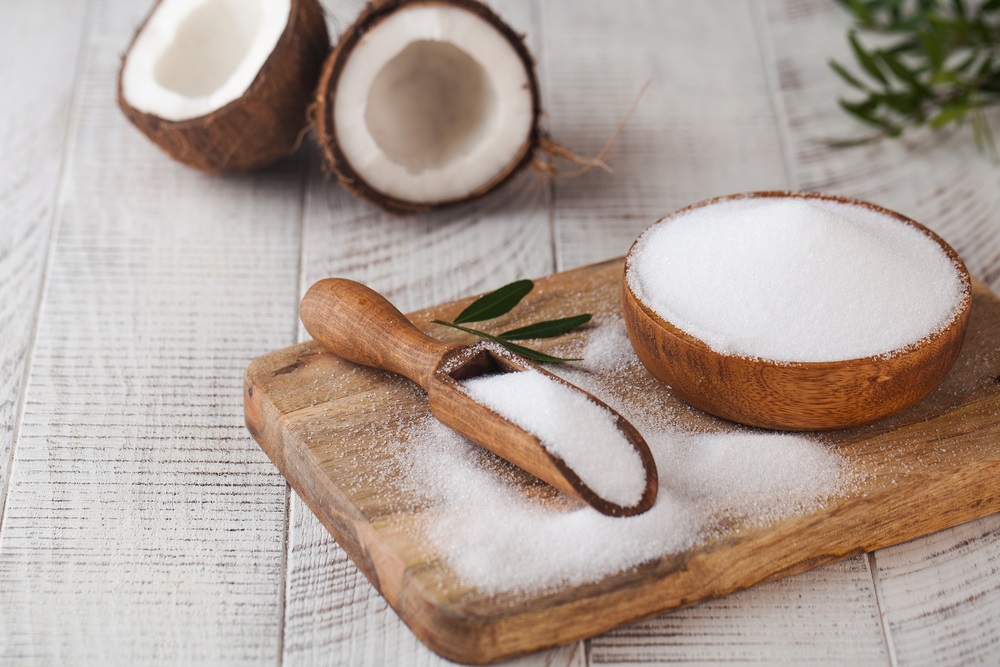
What is erythritol and which products contain it?
A sponge made with erythritol leaves its tin the same pale colour it went in. So what is erythritol like to bake with? Where a recipe asks for 100 g of sugar, you weigh out about 125 g instead. Browning never happens with it, whatever the oven temperature and however long the tin stays inside.
Key takeaways:
- A sugar alcohol: erythritol is a polyol labelled E968, made by fermentation.
- Less sweet: it carries 60 to 80% of the sweetness of sugar.
- Slow to dissolve: about 54 g goes into 100 g of water at 20°C, against roughly 200 g for sugar.
- Cool on the tongue: the crystals take heat from the mouth as they dissolve.
- Not automatic: plenty of sugar-free packs run on maltitol, xylitol or steviol glycosides.
What is erythritol?
Erythritol is a sugar alcohol, a polyol declared on labels as E968, obtained by fermenting a carbohydrate source with yeasts and then purifying and drying the crystals. That is the whole laboratory answer. At a worktop, erythritol is a white, free-flowing sweetener that looks like caster sugar and behaves nothing like it.
In the UK it is sold by the kilo, and it is the same food-grade material that ends up inside factory-made sweets. A bag of erythritol 1 kg declares a single ingredient, erythritol 100%, and per 100 g gives 0 kJ / 0 kcal, 99.78 g of carbohydrate, of which none are sugars and 99.78 g are polyols. Net weight is 1 kg and the country of manufacture is Poland.
Which products contain erythritol?
Erythritol products split into two groups: bags of loose crystals sold as a sweetener, and finished foods where the polyol sits somewhere in the ingredients list. The declaration on the back settles which products contain erythritol, because a sugar-free flash on the front covers maltitol, xylitol, steviol glycosides and erythritol alike.
Erythritol turns up in three kinds of pack:
- Loose crystals weighed out for sweetening drinks, dishes and baking.
- Sugar-free confectionery such as lollipops, wafers, protein bars, biscuits and mini bars, usually blended with a second sweetener.
- Chocolate without added sugar, where the choice of polyol changes from bar to bar.
Among the sugar-free sweets we stock, the strawberry and cherry lollipops from Bunny Ninja declare their sweeteners as isomalt, erythritol and steviol glycosides, three of them in one small lolly. That mix is typical in confectionery: erythritol carries part of the sweetness and the other two sweeteners fill in the rest.
Why does erythritol taste cooling?
The chill is physical rather than a matter of flavour: the crystals take heat from the mouth as they dissolve, and the tongue reads that small drop in temperature as cold.
The erythritol cooling effect is strongest in dry, crystalline foods: a spoonful stirred into cold yoghurt, a dusting over fruit, a mix eaten before it has met any liquid. Dissolve the same crystals in warm liquid first and the sensation largely disappears, because the heat has already come out of the pan. In small amounts the chill reads as freshness and suits mint, citrus and cocoa; across a whole bowl of icing it can drift towards menthol.
How do you bake with erythritol?
Baking with erythritol works when you give it one job, sweetening, and the other ingredients cover the rest. Start at roughly 125 to 165 g of erythritol for every 100 g of sugar in the recipe and taste from there. The range is wide because the crystals carry only part of the sweetness of sugar, and because sugar also brings bulk, moisture and colour. Erythritol sweetens, and that is where its work in the tin ends.
Three things keep the result predictable:
- Grind it finer: powdered crystals disappear into batter and icing instead of sitting in them.
- Keep the moisture up: yoghurt, apple purée or a little more fat cover what sugar used to hold.
- Expect a pale crust: colour has to come from cocoa, egg wash or wholemeal flour.
The colour is where the swap shows most, because erythritol does not caramelise and a pale top is simply normal, not a sign of an underbaked cake. The sweetener sits with the rest of the sugar and sweeteners we keep, next to xylitol, coconut sugar and stevia, so a recipe that calls for two of them can be shopped in one go.
Erythritol and xylitol: what is the difference?
Xylitol is about as sweet as sugar while erythritol falls short of it, and that single gap pulls everything else along with it. Erythritol vs xylitol therefore follows what you are making: a mixture that needs full sweetness leans one way, a crisp biscuit or a dusting leans the other.
Sweetness and quantity, with both polyols in one view:
Sugar-free chocolate shows the split plainly. Bars on the healthy chocolate shelf are sweetened in different ways, and where erythritol is the sweetener, that cool note travels into the bar itself.
Choosing products with erythritol: what to remember
How well a pack suits you depends on how much of the sweetening erythritol really does, and ingredients are listed by falling weight. A pack with more than 10% added polyols must also warn that excessive consumption may have a laxative effect. Orders over £89 ship free across England, Wales, Scotland and Northern Ireland. Match the polyol to the recipe before you fill the basket, and the next bake will start from the right bag!
Frequently asked questions about erythritol
Is erythritol the same as sugar alcohol?
It is one of them: sugar alcohol, or polyol, is the family name, and erythritol shares it with xylitol, maltitol and sorbitol.
How do you convert erythritol to sugar in a recipe?
Weigh both rather than measuring by the spoon, since the crystals pack differently, and test the new ratio on one small batch before you commit a whole tray.
Does erythritol dissolve in cold drinks?
Slowly, and a spoonful can sit at the bottom of an iced glass for minutes. Stir it into the drink before the ice goes in, and give it a minute in the glass.
Why does erythritol crystallise in baking?
A concentrated mixture holds more dissolved erythritol hot than cold, so as the bake cools the excess comes back out of solution as fine grit.
Which sweets are made with erythritol?
Sweets that name it in the sweeteners bracket on the label, such as the strawberry and cherry lollipops we stock, where it appears with isomalt and steviol glycosides.